
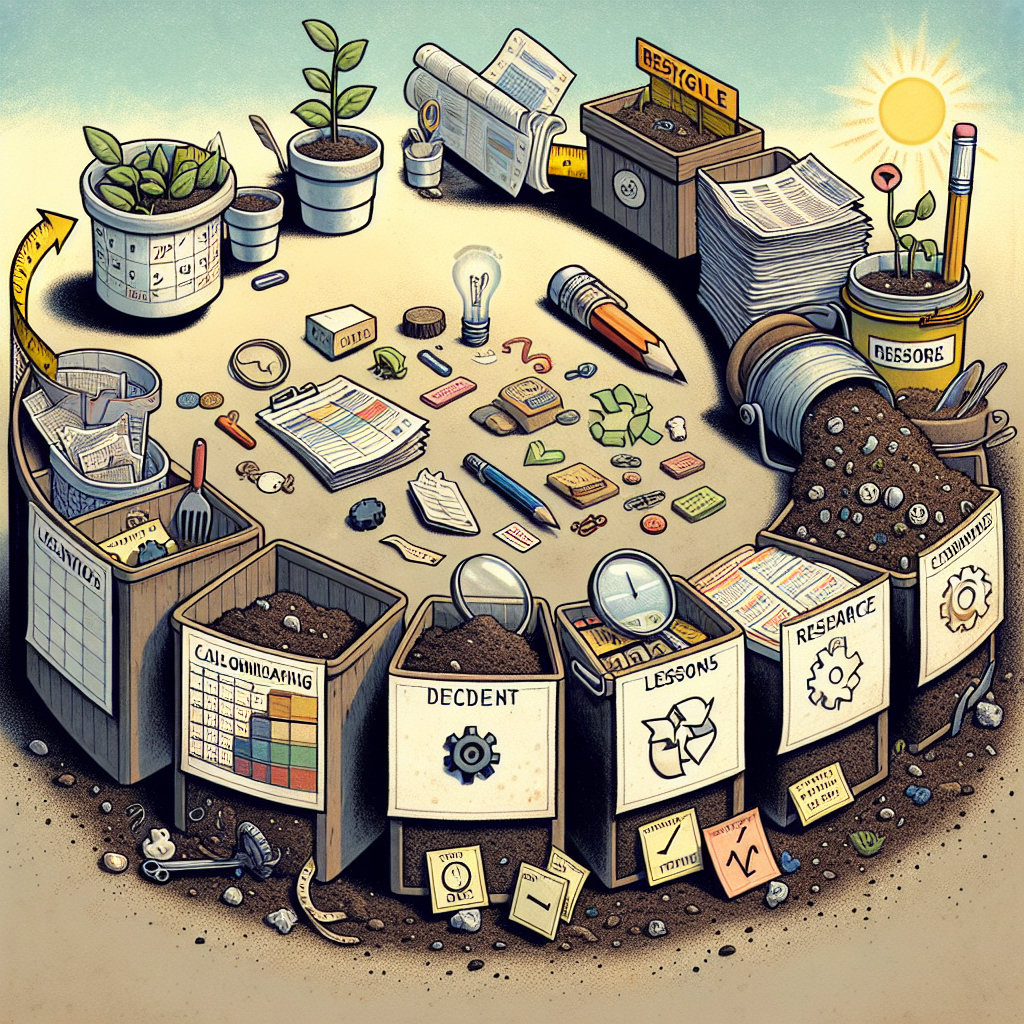
Goal Composting: turn failed plans into soil for new ideas
It’s Monday morning. You’ve mapped out a tidy plan: gym before work, inbox to zero by lunch, finally draft that proposal after a quick arvo coffee. By Thursday, the plan is composting at the bottom of your bag. By Friday, you’re avoiding your planner altogether. Sound familiar?
Don’t bin it. Compost it.
Most of us treat failed plans like rubbish: we chuck them and start fresh, a little more cynical each time. What if, instead, you turned every misfire into nutrients for the next idea? That’s goal composting—breaking down what didn’t work to feed what will.
Composting doesn’t romanticise failure. It recycles it. You keep the useful bits, rewrite the unhelpful narratives, and replant—smarter.
A simple, science-backed loop
Here’s a practical way to compost any failed plan into something healthier.
- 1) Do a 10‑minute debrief while it’s fresh. Ask:
- What actually happened (just the facts)?
- What parts worked, even a little?
- What got in the way (time, energy, timing, assumptions)?
- 2) Strip the plan into ingredients. Separate:
- Assets: checklists, drafts, contacts, calendar blocks, scripts.
- Assumptions: “I can write for 90 minutes after a full day.”
- Constraints: kids’ sport, commute, budget, winter light.
- 3) Harvest lessons as principles, not judgements. Turn pain points into rules of thumb:
- “Deep work works best before 10 a.m.”
- “If a task needs >60 minutes, schedule it on Tues/Thurs.”
- 4) Salvage and reuse. Don’t start from zero. Recycle:
- Slides into short posts.
- Research into a template or checklist.
- Half-written draft into a thread or newsletter segment.
- 5) Swap outcomes for inputs (for a fortnight). Instead of “Run 25 km this week,” use “Run 20 minutes, four times.” Inputs build consistency; consistency builds outcomes.
- 6) Run a micro‑experiment. One tiny tweak, one week:
- “Try 25‑min work sprints at 8:30 a.m., three days.”
- “Move gym to lunch, 3× this week.”
Pre‑decide a failure budget: how many misses you’ll tolerate before you iterate (e.g., “Two no‑shows allowed”).
- 7) Build a compost bin for ideas and scraps. Keep a single capture spot labelled:
- Seeds: new ideas to try soon.
- Sprouts: ideas currently being tested.
- Compost: past plans, notes, and lessons to draw on.
Schedule a 20‑minute monthly review to turn compost into “fertiliser”: pick one lesson, one reusable asset, and one experiment for the next month.
- 8) Reframe the story. Write two short paragraphs:
- Paragraph 1: What I tried and why it didn’t suit my season.
- Paragraph 2: What I’m trying next, and the smallest sign it’s working.
Real people, real compost
“I tried a daily newsletter and flamed out in two weeks. I kept the backlog of links, switched to a weekly ‘3‑things’ format, and wrote on Saturday mornings with a flat white. Same value, better rhythm.” — Sam, designer in Melbourne
“Our team’s monthly webinar never got traction. We carved it into four 4‑minute videos, repurposed the slides as a lead magnet, and booked five sales calls the next month.” — Priya, SaaS marketer
“Winter wrecked my marathon plan. I composted it into ‘10‑minute movement daily’ plus a weekend bushwalk. By spring, the habit was back and the kilometres followed.” — Alex, researcher
Make it easy to stick with
You can run this system with pen and paper or whatever app you already use. If you want something simple and effective for planning and tracking goals, Meloplan is a neat fit. Set a goal, track the daily inputs that matter, and jot a quick debrief when things wobble. I keep three lists in Meloplan—Seeds, Sprouts, Compost—and tag items as I go. A monthly review takes about 15 minutes and keeps the garden growing.
Quick checklist to try this week
- Pick one “failed” plan from the last month.
- Do the 10‑minute debrief: facts → assets → constraints.
- Write two lessons as principles.
- Salvage one asset for reuse.
- Design a 7‑day micro‑experiment with an input metric.
- Book a 20‑minute “compost to fertiliser” review next Friday.

Leave a Reply